









If you have come across the word witelovers in a search result, social post, blog, or lifestyle article, you may have paused for the same reason as many other readers: the term sounds familiar, but its meaning is not immediately obvious.
That uncertainty is understandable. Witelovers is not a conventional design movement with an official handbook, recognized founder, or universally accepted definition. Current online sources use the term in several ways, but the strongest recurring interpretation connects it with clean spaces, light or neutral colors, minimal decoration, organization, simple living, and visual calm.
There is also an important distinction between what is commonly associated with the term and what can actually be verified about its history. Claims about its exact origin or the meaning of the spelling are inconsistent across websites.
So, instead of forcing one definition onto the word, this guide looks at how witelovers is currently being used, where it overlaps with minimalism, how the aesthetic can be applied to interiors, fashion, photography, and everyday routines, and what remains uncertain.
What Does Witelovers Mean?
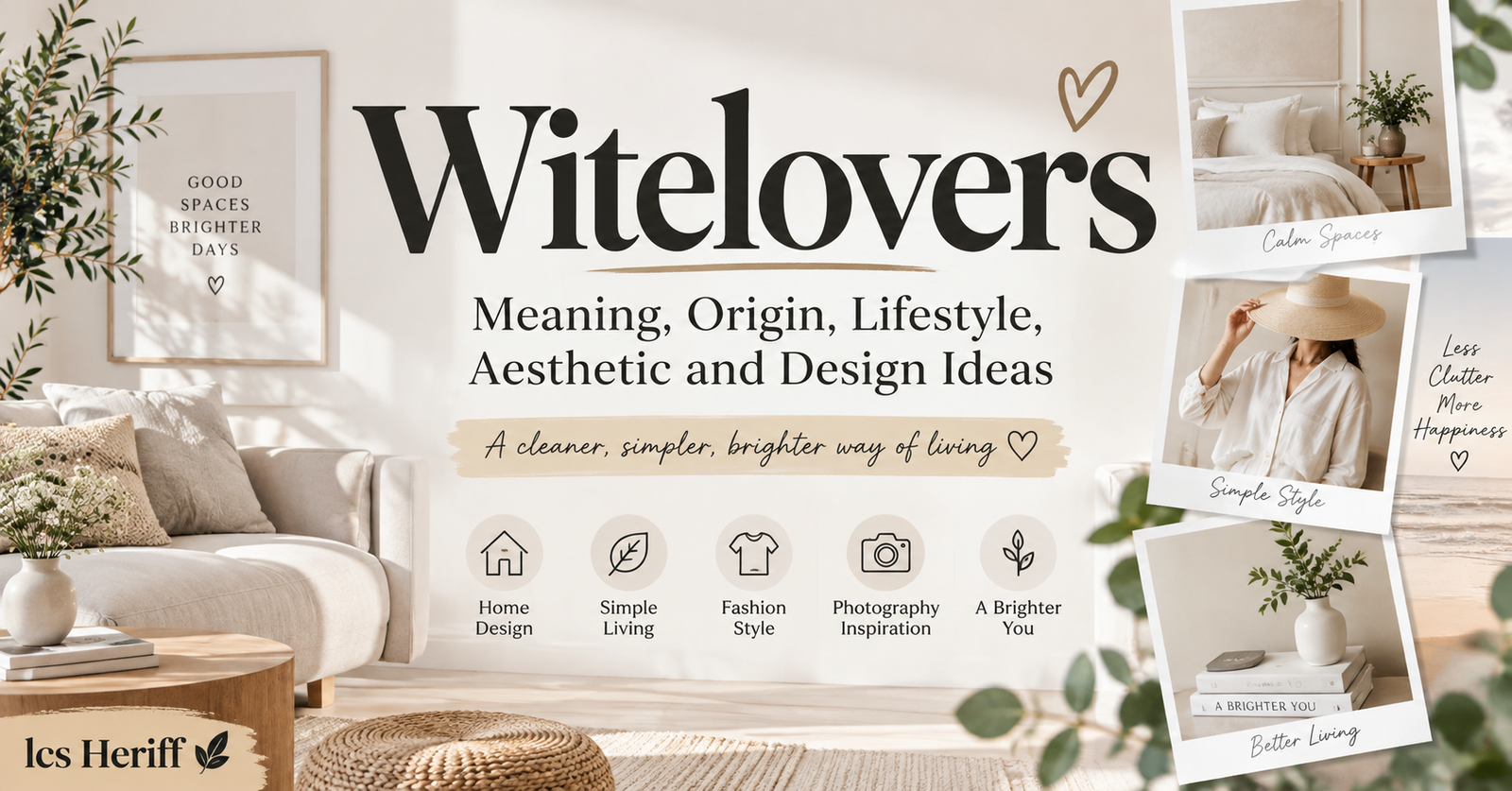
Witelovers is an informal online term commonly associated with a preference for clean, bright, simple, and visually uncluttered surroundings.
In lifestyle and design discussions, it is often connected with:
- White, cream, beige, and soft gray tones
- Minimalist or simple interiors
- Organized rooms
- Natural light
- Functional furniture
- Clean photography
- Simple clothing
- Uncluttered workspaces
- Intentional purchasing
- Calm visual environments
The term is best treated as a flexible aesthetic label, rather than a formal lifestyle system.
Recent articles repeatedly describe witelovers in connection with minimalist design and simple living, while also acknowledging that there is no official definition.
That distinction matters because minimalism itself has a much longer and better-documented history. Witelovers appears to be a newer internet expression built around ideas that already exist in interior design, fashion, photography, and lifestyle culture.
The simplest definition
If someone asks, “What is witelovers?” the most defensible short answer is:
Witelovers is an emerging online term associated primarily with clean aesthetics, neutral colors, organized spaces, simple living, and minimalist-inspired design.
The exact meaning can change depending on context.
Is Witelovers a Real Lifestyle Trend?
It is safer to call witelovers an emerging online aesthetic or lifestyle label than an established lifestyle movement.
There is no clearly documented organization controlling the term, no universally recognized membership, and no official set of rules that followers are expected to follow. Current coverage instead shows different publishers using the word to describe related ideas around simplicity and visual order.
That does not make the concept meaningless.
Many modern aesthetic labels work this way. People gather around a recognizable visual style first and only later develop a vocabulary for describing it.
Witelovers fits naturally alongside concepts such as:
- Minimalism
- Scandinavian-inspired interiors
- Neutral interior design
- Simple living
- Capsule wardrobes
- Decluttering
- Intentional consumption
- Clean photography
- Organized workspaces
The name may be new, but many of the underlying design principles are not.
Where Did Witelovers Come From?
This is where caution is necessary.
There is no reliably documented founder, launch date, original creator, or authoritative source establishing exactly where the term began. Recent websites generally acknowledge that its origin is unclear.
The spelling has also produced competing interpretations.
Some lifestyle articles suggest a relationship between “wite” and “white,” essentially connecting the term with an appreciation for white or light colors. Others offer completely different explanations. One current article, for example, interprets the term as a stylized version of “wife lovers,” illustrating how inconsistent the etymological claims are.
There is not enough reliable evidence to select one of those explanations as the confirmed origin.
What can actually be said?
The evidence supports a more careful conclusion:
Witelovers is an internet-era term whose exact linguistic origin has not been firmly established. Its present-day lifestyle usage is much clearer than its historical origin.
That is an important distinction for anyone writing about the keyword.
Why Is the Meaning of Witelovers Unclear?
There are several reasons.
The term does not have a standard reference definition
Established concepts usually have relatively stable definitions. Witelovers does not currently have that level of standardization.
Different websites interpret it differently
Some articles focus almost entirely on minimalist interiors. Others expand the term into fashion, digital identity, online communities, or lifestyle behavior.
Internet vocabulary changes quickly
Online language can develop through captions, usernames, hashtags, communities, blogs, and social platforms without passing through a formal naming process.
Repetition can create the appearance of authority
This is particularly important when researching obscure keywords.
If ten websites repeat the same explanation, it may look well established. But those ten pages could ultimately be repeating one original article or one unsupported assumption.
For that reason, number of search results should not be confused with quality of evidence.
Witelovers and Minimalism: Are They the Same?
No.
The two overlap heavily, but they are not identical.
| Witelovers | Minimalism |
|---|---|
| Emerging online term | Established design and lifestyle concept |
| Often emphasizes light and neutral aesthetics | Can use many different visual styles |
| Frequently associated with white, cream, beige, and gray | Focuses more broadly on reducing excess |
| Strongly connected with visual presentation | Applies to design, art, architecture, lifestyle, and consumption |
| No fixed rules | Has a much longer documented history |
| Meaning remains flexible | Core principles are more clearly established |
A minimalist room does not need to be white.
Likewise, a witelovers-inspired room does not have to contain almost nothing.
This is one of the most useful distinctions for readers. The aesthetic can borrow from minimalism without becoming identical to it.
The Witelovers Color Palette
Color is one of the easiest ways to recognize the aesthetic.
A typical interpretation favors colors such as:
- White
- Off-white
- Ivory
- Cream
- Beige
- Sand
- Light gray
- Pale taupe
- Natural wood tones
But there is no reason to interpret the style as an absolute “everything must be white” rule.
In fact, using only one color can make a room feel flat rather than sophisticated.
A better approach is to create layers of closely related tones.
For example:
| Element | Possible choice |
|---|---|
| Walls | Warm white |
| Sofa | Cream or light beige |
| Rug | Ivory |
| Wood | Natural oak |
| Curtains | Soft linen |
| Accessories | Light gray |
| Plants | Natural green |
| Metal details | Muted finish |
This produces visual consistency without making the space sterile.
How to Create a Witelovers-Inspired Room
You do not need to replace all your furniture.
The aesthetic is easier to achieve by changing the visual relationship between objects.
Start by reducing visual clutter
Look around the room and identify objects that do not serve a useful or decorative purpose.
Remove things that:
- Are rarely used
- Have no clear storage location
- Make surfaces look crowded
- Duplicate something you already own
- Distract from the room’s main purpose
The objective is not to own as little as possible.
It is to make the things you keep easier to see and use.
Use negative space
One of the easiest ways to create a minimalist appearance is simply to leave some space empty.
A table does not need to be covered with decorations.
A shelf does not need an object on every section.
An open area can actually make the furniture that remains feel more intentional.
Choose fewer, better accents
Instead of placing ten small decorative items around a room, choose two or three pieces that have a stronger visual relationship.
For example:
- One large artwork
- One ceramic vase
- One plant
can often create a cleaner composition than a shelf filled with unrelated objects.
Let natural light do some of the work
Bright interiors often depend heavily on lighting.
Large windows, sheer curtains, mirrors, pale walls, and reflective surfaces can help distribute natural light.
Artificial lighting also matters. Warm, diffused lighting can prevent a predominantly white room from feeling harsh at night.
Witelovers and Furniture
Furniture should support the room rather than dominate it.
Good choices for this aesthetic often include:
- Simple silhouettes
- Straight or gently curved lines
- Functional storage
- Natural materials
- Neutral upholstery
- Low visual clutter
That does not mean every piece needs to come from the same collection.
Mixing materials can actually make a neutral room more interesting.
For example, combine:
light wood + linen + ceramic + glass + greenery
The palette remains calm while the textures provide contrast.
Witelovers in Fashion
The same visual principles can extend beyond interiors.
A witelovers-inspired wardrobe might emphasize:
- White shirts
- Cream sweaters
- Beige trousers
- Neutral jackets
- Simple sneakers
- Minimal accessories
- Clean silhouettes
- Soft fabrics
This overlaps with the concept of a capsule wardrobe, where a relatively small collection of versatile clothing items can create many combinations.
Again, the point is not to impose a strict uniform.
A neutral wardrobe can still include personality.
A dark watch, textured bag, muted green jacket, or subtle piece of jewelry can create contrast without destroying the overall aesthetic.
The same visual principles can extend beyond interiors into fashion and personal style, where neutral colors, clean silhouettes, and simple pieces can create a consistent visual identity.
Witelovers and Photography
Photography is another natural fit because neutral environments tend to produce a recognizable visual identity.
Common characteristics include:
- Soft lighting
- Bright backgrounds
- Limited color palettes
- Clean compositions
- Negative space
- Natural materials
- Minimal props
This can work particularly well for:
- Home decor photography
- Product photography
- Fashion content
- Lifestyle blogs
- Pinterest-style images
- Instagram feeds
- Brand photography
The biggest mistake is assuming that “minimal” means “empty.”
A strong minimalist photograph still needs composition, hierarchy, texture, and a clear subject.
Witelovers for a Workspace
A clean workspace can be attractive, but functionality should come first.
A practical setup might include:
- A desk with enough working space
- A comfortable chair
- Cable management
- One or two useful accessories
- Adequate lighting
- Organized storage
- A limited number of visible objects
For a digital worker or student, this can be particularly useful.
Instead of keeping notebooks, chargers, papers, bottles, and miscellaneous objects scattered across the desk, give each category a designated location.
The result is not simply prettier.
It can also make it easier to find things quickly.
Witelovers and Simple Living
The lifestyle interpretation goes beyond decoration.
At its broadest, simple living involves being more deliberate about what enters your home, schedule, wardrobe, and digital environment.
A practical version might look like:
- Buying fewer unnecessary items
- Repairing useful possessions
- Keeping frequently used objects accessible
- Reducing duplicate purchases
- Maintaining simple routines
- Organizing digital files
- Limiting visual clutter
- Spending more intentionally
This is where the concept becomes more useful than a purely decorative trend.
A beautiful white room does not automatically represent simple living.
A modest room that is functional, organized, and comfortable may fit the underlying philosophy much better.
Is Witelovers About Mental Peace?
Some current lifestyle articles connect the aesthetic with calmness, reduced visual stimulation, and a feeling of order.
That idea should be treated carefully.
A tidy environment can feel pleasant, and many people prefer organized surroundings. But it would be too strong to claim that adopting a particular color palette automatically improves mental health or guarantees productivity.
The more defensible practical idea is simple:
Your environment can influence how easy it is to work, relax, find possessions, and maintain routines.
The effect will vary from person to person.
Witelovers vs. Other Popular Aesthetics
Understanding neighboring styles makes the concept easier to place.
| Style | Main emphasis | Typical visual character |
|---|---|---|
| Witelovers | Light, clean, simple aesthetic | White and neutral tones |
| Minimalism | Reduction and function | Uncluttered, restrained |
| Scandinavian | Function, comfort, simplicity | Light wood, soft neutrals |
| Japandi | Japanese restraint + Scandinavian warmth | Natural materials, muted colors |
| Modern | Clean architectural forms | Structured, polished |
| Maximalism | Abundance and expression | Layered colors and objects |
| Cottagecore | Rustic, nature-oriented charm | Floral, vintage, warm |
| Industrial | Raw materials and structure | Metal, concrete, darker tones |
Witelovers can borrow visual elements from several of these styles.
That flexibility is one reason the term can be useful as a descriptive label even though it is not a formal design school.
Benefits of a Witelovers-Inspired Approach
There are several practical advantages to adopting selected elements of the aesthetic.
Easier visual organization
Fewer competing objects can make a room easier to visually understand.
Greater design consistency
A limited color palette makes it easier to combine furniture and accessories.
Easier purchasing decisions
If you have a defined palette, you can quickly reject items that do not fit your space.
More flexible decoration
Neutral foundations allow seasonal or colorful accents to be changed without redesigning the entire room.
Better use of space
Reducing unnecessary furniture can make smaller rooms feel more open.
But these are design advantages, not guaranteed psychological or health outcomes.
The Downsides People Often Ignore
A good guide should also discuss the limitations.
Too much white can feel cold
If every surface is bright white, the space may lack warmth.
Minimalism can become impractical
Removing useful storage or furniture simply because it looks “minimal” creates a room that photographs well but works poorly.
Maintenance can increase
White upholstery, rugs, walls, and clothing can show dirt more easily.
Trends can encourage unnecessary spending
Buying a new collection of neutral furniture just to achieve an aesthetic defeats the idea of intentional consumption.
Personal identity can disappear
A room does not need to look like a catalog to be attractive.
Books, artwork, souvenirs, photographs, plants, and colorful objects can make a space feel lived-in.
How to Follow the Aesthetic Without Overdoing It
You do not have to rebuild your entire life around a trend.
Try the 70/20/10 approach:
- 70% neutral foundation
- 20% texture and natural materials
- 10% personal or contrasting accents
For example:
70%: white walls, cream sofa, beige rug
20%: wood table, linen curtains, woven basket
10%: green plant, artwork, dark lamp, or colored cushion
This preserves the clean appearance while keeping the room personal.
A Practical Witelovers Room Checklist
Before buying anything, ask:
- Does this object have a purpose?
- Does it work with my existing colors?
- Will I still like it next year?
- Does it improve the room or simply fill space?
- Do I already own something that does the same job?
- Is it easy to clean?
- Does it fit the available space?
- Does it reflect my personality?
Those questions are more valuable than blindly following an aesthetic label.
Witelovers in Digital Spaces
The term can also appear outside physical design.
Some current sources use witelovers more broadly as an online identity, community label, or digital-cultural expression.
This broader usage is less standardized than the minimalist interpretation.
If you see the word attached to a username, hashtag, community, website, or social profile, do not automatically assume that it refers to interior design.
Context matters.
Look at the surrounding posts and descriptions before deciding what the person or community means by it.
How to Research an Unfamiliar Internet Term
Witelovers offers a useful lesson in online research.
When a word has no clear dictionary definition, use a few basic checks.
Compare multiple independent sources
Do not rely on one article.
Look for primary evidence
An original post, creator statement, archived page, or dated discussion can be more useful for determining origin than a modern article repeating an old claim.
Separate usage from etymology
A term may clearly be used in a particular way even when nobody knows where its spelling originated.
Watch for copied claims
If several websites use almost identical wording, they may not represent independent confirmation.
Distinguish established concepts from new labels
Minimalism, capsule wardrobes, and Scandinavian design have established histories. Witelovers does not appear to have the same level of formal documentation.
This approach is useful well beyond this particular keyword.
What Does Witelovers Mean in Simple Words?
For a featured-snippet-style answer:
Witelovers is an informal internet term most commonly associated with clean, bright, neutral aesthetics, minimalist-inspired interiors, organized spaces, simple fashion, and intentional living. It does not currently have a universally accepted definition, official founder, or fixed set of rules.
That definition captures the strongest recurring interpretation without pretending that uncertain claims are established facts.
Is Witelovers Only About White?
No.
White appears frequently in descriptions of the aesthetic, but the broader visual idea includes:
- Cream
- Beige
- Ivory
- Gray
- Natural wood
- Soft earth tones
- Muted colors
The underlying concept is generally visual simplicity and balance, not a requirement that every object be white.
Is Witelovers the Same as “White Lovers”?
The connection is suggested by some online explanations, but it should not be presented as a confirmed etymology.
The spelling may encourage that interpretation, particularly because many current lifestyle articles associate the term with white and neutral aesthetics. But there is currently no strong authoritative source establishing exactly how the name was created.
Is Witelovers a Brand?
There is no clear evidence establishing one universally recognized company or brand called Witelovers that owns the term.
Online, the word currently appears primarily as a search keyword, aesthetic label, lifestyle concept, and broader digital expression.
If a specific website or company uses the name commercially, that particular use should be evaluated separately from the general meaning of the term.
Why Is Witelovers Appearing in Search Results?
Search engines often expose users to new terminology before that terminology becomes widely understood.
An unfamiliar word can generate searches because people encounter it in:
- Articles
- Social-media posts
- Images
- Hashtags
- Blogs
- Product descriptions
- Usernames
- Online communities
Once people begin searching for the word, publishers have an incentive to explain it.
That creates a feedback loop:
new term → curiosity → searches → articles → more exposure → additional searches
Witelovers appears to fit this type of search-driven discovery pattern. Current articles specifically describe people encountering the term online and looking for an explanation.
The Most Useful Way to Think About Witelovers
You do not need to treat witelovers as a strict lifestyle philosophy.
Think of it as a flexible descriptive label.
Take the parts that are useful:
- Cleaner spaces
- Better organization
- Neutral colors
- Functional furniture
- Less visual clutter
- More intentional purchases
- Personal design choices
Ignore the parts that do not suit your home or lifestyle.
Aesthetic trends are most useful when they provide inspiration rather than rules.
Frequently Asked Questions About Witelovers
What is Witelovers?
Witelovers is an emerging online term most commonly associated with clean aesthetics, neutral colors, organized spaces, minimalist-inspired interiors, simple fashion, and intentional living. It does not have one official definition.
What does Witelovers mean?
The most common lifestyle interpretation describes a preference for bright, simple, uncluttered surroundings. The term can also be used more broadly online, so its exact meaning depends on context.
Is Witelovers a form of minimalism?
It overlaps with minimalism but is not the same thing. Minimalism is a much older and broader concept, while witelovers is a newer, loosely defined internet term often focused more strongly on light and neutral aesthetics.
Does Witelovers mean everything has to be white?
No. White is commonly associated with the aesthetic, but cream, beige, gray, natural wood, and other muted colors can also fit the style.
Where did Witelovers originate?
Its exact origin is uncertain. Current sources do not establish a verified founder, creator, first publication, or official launch date. Different websites offer competing explanations.
Is Witelovers an official design movement?
No established evidence currently supports describing it as a formal design movement. It is better described as an emerging online aesthetic or lifestyle label.
Can Witelovers be used in fashion?
Yes. The term is sometimes extended beyond interiors to simple clothing, neutral outfits, clean silhouettes, and restrained accessories.
Can I use Witelovers ideas in a small room?
Yes. Decluttering, using a restrained color palette, choosing appropriately scaled furniture, and leaving some open space can work particularly well in smaller rooms.
Does Witelovers require expensive furniture?
No. The aesthetic is based more on visual consistency, organization, proportion, and restraint than on price. Reusing existing furniture may be more consistent with intentional consumption than replacing everything.
Is Witelovers the same as simple living?
Not exactly. Simple living is a much broader lifestyle idea. Witelovers is generally used as an aesthetic or online label, although some sources extend it into lifestyle habits.
Why are people interested in Witelovers?
The term is easy to connect with existing interests in minimalist interiors, neutral fashion, decluttering, organization, and visually calm online content. Its unfamiliar name also creates curiosity and search interest.
Does Witelovers have a fixed set of rules?
No. There is no recognized rulebook. Different people can use the term to describe somewhat different versions of the same broad preference for simplicity and visual clarity.
Final Takeaway
Witelovers is best understood as an emerging, loosely defined internet term rather than a formally established movement.
Its strongest recurring interpretation is connected with clean design, neutral colors, organized spaces, minimal decoration, simple living, and calm visual aesthetics. Current online sources support that association, but they do not establish a universally accepted definition or reliable historical origin.
That distinction makes the term more interesting, not less.
The useful ideas behind the aesthetic—reducing clutter, choosing functional objects, using balanced colors, creating breathing room, and making intentional purchases—can stand on their own. You do not need to follow a rigid internet trend to benefit from them.
And if you encounter the word in a completely different context, check the surrounding content before assuming that it means minimalist design. The current search landscape shows that context remains the most reliable guide to witelovers.
