










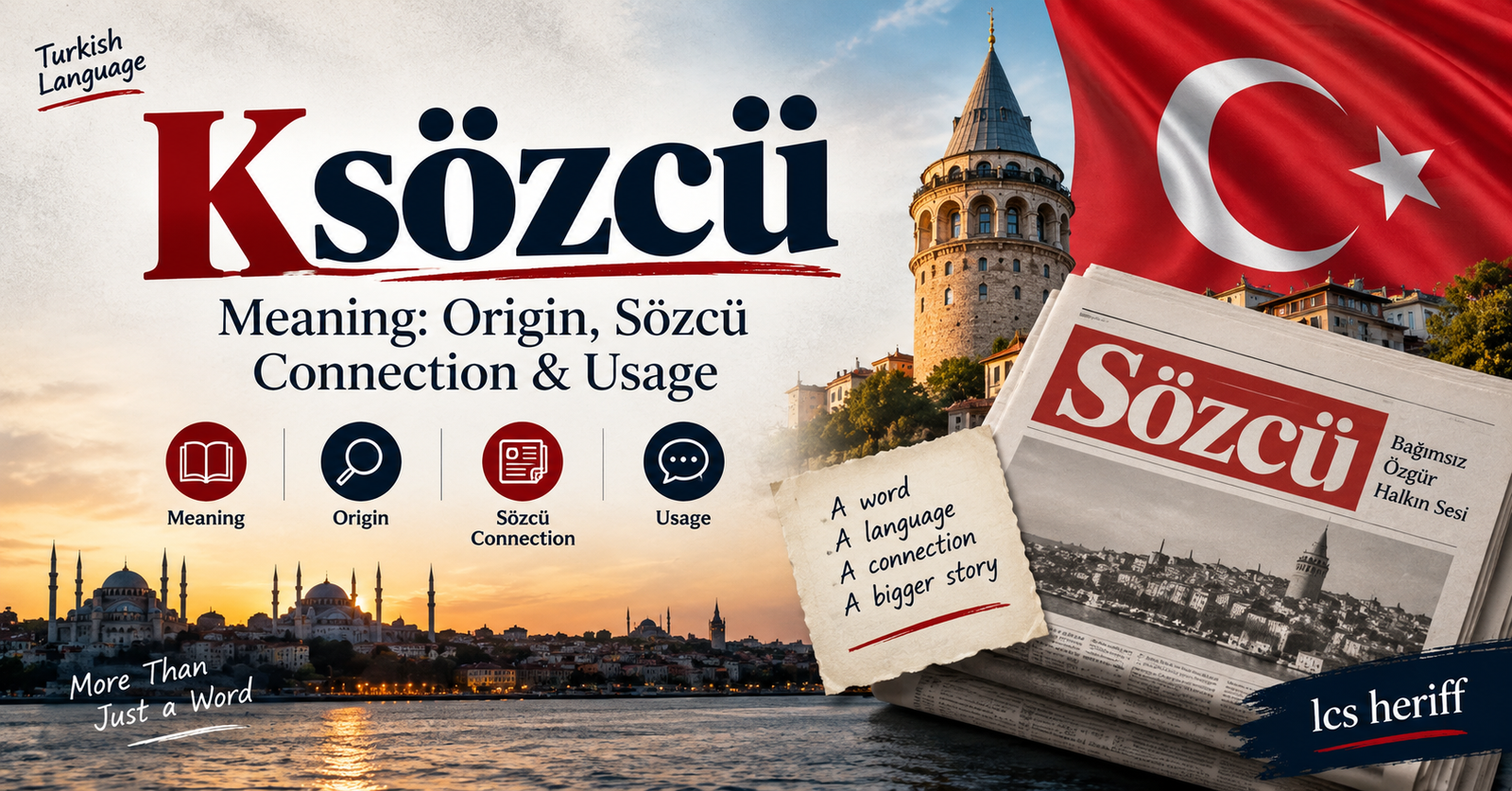
Some words are easy to understand the moment you see them. Others make you stop and ask, “What exactly is this supposed to mean?”
Ksözcü falls into the second category.
The unusual spelling makes it look like a Turkish word, a brand, a digital term, or perhaps the name of a media platform. That uncertainty is exactly why people search for it.
The key to understanding the term is the Turkish word sözcü. Cambridge Dictionary translates spokesperson into Turkish as sözcü, meaning a person selected to officially speak for a group or organization.
The extra K in ksözcü, however, requires more caution. There is no strong evidence that it creates a separate, established Turkish word with its own universally accepted dictionary definition. Instead, current online usage suggests several possibilities, including a typo, stylized spelling, search variation, username, or reference associated with Sözcü.
What Does Ksözcü Mean?
The safest interpretation is that ksözcü is a nonstandard or stylized variation associated with the Turkish word “sözcü.”
The standard word sözcü means:
- spokesperson
- representative
- speaker
- someone who officially speaks for another person or organization
For example, a government may appoint a spokesperson to answer journalists’ questions. A company can have a spokesperson who communicates official announcements. A sports club may also designate someone to represent the organization publicly.
In each case, the central idea is speaking on behalf of someone else.
The unusual spelling ksözcü should therefore not automatically be treated as a completely separate Turkish vocabulary item.
The Important Difference
| Term | Status | General meaning |
|---|---|---|
| sözcü | Standard Turkish word | Spokesperson or representative |
| ksözcü | Nonstandard/unclear variation | Usually interpreted in connection with sözcü |
| Sözcü | Also a media brand/name | Turkish newspaper and digital media organization |
This distinction matters because several websites currently publish explanations that give ksözcü a much more established linguistic history than the available evidence supports.
A good explanation should separate documented meaning from interpretation.
What Does “Sözcü” Mean in Turkish?
To understand ksözcü, it helps to start with the established form: sözcü.
Cambridge defines sözcü as the Turkish equivalent of spokesperson—someone chosen to speak officially for a group or organization.
The word can therefore describe a person who represents:
- a government department
- a political organization
- a company
- a sports team
- a public institution
- a campaign
- an association
- another organized group
Consider a simple example.
A company launches a new product and journalists ask questions about its price, safety, and availability. Instead of having every employee answer separately, the company appoints one person to communicate its official position.
That person is a sözcü.
The English equivalent would normally be spokesperson.
Why Does Ksözcü Look So Unusual?
The unusual appearance comes from the initial K.
The standard Turkish spelling is sözcü, not ksözcü. Current search results do not establish the initial K as a recognized grammatical element that changes the dictionary meaning of sözcü.
That leaves several plausible explanations.
1. It May Be a Typing or Spelling Variation
The simplest possibility is an accidental extra letter.
People frequently make small spelling changes when entering unfamiliar words into search engines. This becomes even more likely with words containing Turkish characters such as ö and ü.
A user who intended to search for sözcü could therefore end up searching for ksözcü.
2. It May Be a Stylized Online Form
Internet users often modify existing words when creating:
- usernames
- website names
- social media handles
- project names
- digital brands
- search-oriented names
An extra letter can make a name available when the original username has already been taken.
However, that does not automatically give the modified spelling a new linguistic meaning.
3. It May Be a Search Keyword Variation
Search behavior also creates unusual keyword variants.
A word may begin appearing on websites because people repeatedly search for a slightly different spelling. Content creators may then publish pages specifically addressing that variation.
This can create a feedback loop:
unusual search → online article → more searches → more indexed pages → increased visibility
That process can make a nonstandard term look much more established than it actually is.
4. It May Be Confused With Sözcü
There is another important possibility: someone searching ksözcü may actually be looking for Sözcü, the Turkish newspaper and media organization.
That distinction is particularly important because Sözcü is not merely a dictionary word. It is also a recognizable media name.
Ksözcü and the Turkish Newspaper Sözcü
Sözcü is the name of a Turkish newspaper that began publication on 27 June 2007. The publication was founded by businessman Burak Akbay. Sözcü’s own published history identifies 27 June 2007 as the beginning of its publication.
Today, the Sözcü brand extends beyond the traditional printed newspaper into digital publishing and other media products.
Its official website also provides access to digital services and Sözcü Plus, including an e-paper experience.
This creates an important SEO and search-intent distinction:
ksözcü ≠ automatically Sözcü
Someone typing ksözcü could be asking about the word, searching for the newspaper, or simply using a spelling variation.
The surrounding search context is what helps determine the intended meaning.
Is Ksözcü a Real Turkish Word?
Based on the available evidence, it is safer not to describe ksözcü as a standard Turkish dictionary word.
The established term is sözcü.
That matters because some online articles make stronger claims about ksözcü’s supposed historical, cultural, or linguistic meaning without clearly distinguishing established evidence from interpretation. Current search results contain several competing explanations, which makes source evaluation especially important.
A trustworthy explanation should therefore say:
Sözcü is the established Turkish word; ksözcü appears to be a nonstandard variation whose specific origin depends on context.
That wording avoids turning an uncertain interpretation into a linguistic fact.
What Is the Origin of “Sözcü”?
The meaning of sözcü is closely connected with söz, a Turkish word associated with words, speech, statements, and verbal expression.
The form sözcü developed within Turkish word formation and refers to someone who speaks for another person or group.
The important point is that this linguistic explanation applies to sözcü, not necessarily to the added K in ksözcü.
That distinction is easy to miss when searching the web because many pages treat the two spellings as if they were interchangeable.
They are not necessarily interchangeable in every context.
Where Might You Encounter Ksözcü?
Because the spelling is unusual, the context around the word is especially important.
You might encounter it in:
- search queries
- blog articles
- social media posts
- usernames
- website names
- digital branding
- discussions about Turkish vocabulary
- pages referring to Sözcü
- automatically generated or user-generated content
If the word appears next to terms such as Türkiye, haber, gazete, gazeteci, son dakika, Sözcü, the intended reference may be the Turkish media organization.
If it appears in a language-learning context alongside words such as Türkçe, kelime, anlam, söz, konuşma, the user may instead be asking about the linguistic meaning of sözcü.
Context is therefore more useful than the spelling alone.
Ksözcü vs. Sözcü: What Is the Difference?
The distinction can be summarized simply.
| Feature | Ksözcü | Sözcü |
|---|---|---|
| Standard Turkish spelling | No clear evidence | Yes |
| Dictionary-style meaning | Unclear/nonstandard | Spokesperson |
| Related to Turkish language | Likely through sözcü | Directly |
| Can appear as a search variation | Yes | Yes |
| Associated with Turkish media | Possibly through search confusion | Yes |
| Safe translation | Depends on context | Spokesperson/representative |
This is also why blindly translating ksözcü as “spokesperson” can be slightly misleading.
The better approach is to explain the relationship first.
Why Are People Searching for Ksözcü?
There isn’t enough reliable evidence to claim one single reason for every search.
Several search behaviors are plausible.
Unfamiliar Turkish spelling
The letters ö and ü can be unfamiliar to people who primarily use English keyboards.
A typo
An extra character can easily appear in a search query.
Interest in Sözcü
Some searches may be attempts to locate the Turkish newspaper or its website.
Curiosity about an unusual word
Once a strange-looking term appears in a search result, people naturally want to know what it means.
Online content propagation
Once several websites publish pages about an unusual keyword, additional searches can be generated by people encountering those pages.
This last point is particularly relevant to SEO: search volume does not automatically prove that a term has an established linguistic meaning.
How Should You Interpret Ksözcü in Different Contexts?
The surrounding words provide useful clues.
| Context | Most likely interpretation |
|---|---|
| Turkish vocabulary | Variation or mistaken spelling of sözcü |
| Language-learning page | Spokesperson/representative |
| Turkish news search | Possibly Sözcü media |
| Social media username | Could be a custom identity |
| Website/brand name | Could be a deliberately stylized name |
| Random search result | Requires contextual verification |
This is a useful general rule for unfamiliar keywords: don’t assign a fixed meaning until you know how the word is being used.
Similar uncertainty can appear with terms such as Poieno, where the meaning can depend heavily on how and where the word is used.
What Does Sözcü Mean in Journalism?
In journalism, sözcü can refer to a spokesperson who communicates information on behalf of an organization.
For example, during a press conference, journalists may direct questions toward an official spokesperson rather than directly questioning every department or employee.
The role involves more than simply speaking.
A spokesperson may need to:
- understand the organization’s position
- explain complicated information clearly
- answer questions
- avoid misrepresenting facts
- communicate under pressure
- distinguish official statements from personal opinions
That is why the English term spokesperson is generally the closest straightforward translation.
Why Accuracy Matters When Explaining Ksözcü
Unusual keywords create a common research problem: the first explanation found online is not necessarily the most authoritative one.
A page may confidently claim that a word has:
- an ancient origin
- a special cultural meaning
- a hidden symbolic interpretation
- a modern linguistic transformation
But confidence in the writing does not prove the claim.
For language-related queries, a stronger research process is to compare:
- established dictionaries
- authoritative language resources
- native-language usage
- official organization websites
- reputable publications
- search-result context
For sözcü, the dictionary evidence is clear: Cambridge lists it as the Turkish translation of spokesperson.
For ksözcü, the evidence is considerably less definitive.
That difference should remain visible in any responsible article about the term.
The same issue can arise with unusual terms such as Incfidelibus, where spelling variations and competing explanations can make the original meaning harder to establish.
Could Ksözcü Be a Brand Name?
Yes, it could be.
Internet naming does not have to follow conventional dictionary rules.
A company, creator, website, community, or project can intentionally alter an existing word to create a distinctive identity.
For example, a modified spelling may be chosen because:
- the original domain is unavailable
- the social handle is already taken
- the creator wants a unique name
- the spelling is intended to look distinctive
- the term is being used as a fictional or creative identity
But if ksözcü is being used as a specific brand, the brand’s own official documentation should be treated as the primary source for its meaning.
Is Ksözcü the Same as Sözcü Newspaper?
Not necessarily.
The word Sözcü has an established connection with the Turkish newspaper and media group, while ksözcü is a different spelling.
Sözcü’s official website identifies the newspaper as having started publication on 27 June 2007 and provides current digital services under the Sözcü brand.
Therefore, if you encounter ksözcü while searching for Turkish news, it is sensible to check whether the intended query was actually Sözcü.
Don’t assume that an unfamiliar domain or website using a similar spelling is officially connected to the newspaper.
How to Check Whether a Ksözcü Website Is Official
If you find a website using ksözcü or another unusual variation, check:
- the exact domain name
- whether the site identifies its publisher
- its contact information
- official social profiles
- links from the recognized organization
- whether the organization itself confirms the domain
- spelling and branding consistency
For the actual Sözcü organization, the official website uses the sozcu.com.tr domain, and its contact page provides organizational contact details.
This is particularly important when a misspelled or modified keyword is being used to imitate a recognizable brand.
What Is the Best English Translation?
If you are asking about sözcü, the most natural English translation is:
Spokesperson
Depending on the sentence, these can also work:
- representative
- speaker
- official spokesperson
- spokesman
- spokeswoman
“Spokesperson” is generally the best modern neutral choice.
For ksözcü, however, there is no equally certain standalone translation because the term itself is not established in the same way.
The safest English explanation is:
“Ksözcü is an unusual or nonstandard variation associated with the Turkish word sözcü, meaning spokesperson.”
Common Misunderstandings About Ksözcü
Mistake 1: Treating the K as a Turkish grammatical prefix
There is no strong evidence that the initial K functions as a standard prefix that changes the meaning of sözcü.
Mistake 2: Assuming every Ksözcü result refers to a newspaper
The spelling may occur in language, branding, usernames, or search contexts.
Mistake 3: Assuming online explanations are automatically authoritative
Several websites currently provide different interpretations of the word. That variation itself is a reason to check primary and dictionary sources.
Mistake 4: Confusing the keyword with the brand
Sözcü can refer both to a Turkish word and a media organization. Context determines which meaning is intended.
A Practical Way to Understand the Term
If you encounter ksözcü, use this three-step approach:
First, check the spelling.
Ask whether the intended word is actually sözcü.
Second, check the context.
Look at the words surrounding the term.
Third, verify the source.
If the term refers to a company, publication, or website, look for official confirmation.
This simple process prevents a surprisingly common problem in online research: turning a spelling variation into a supposedly established fact.
What Ksözcü Tells Us About Internet Language
There is a broader lesson here.
Search engines constantly expose people to words outside their normal vocabulary. A typo, username, abbreviation, transliteration, or creative spelling can become visible to thousands of users.
Once that happens, content begins forming around the term.
That does not mean the original spelling has suddenly become a formal word.
The internet is full of this kind of linguistic ambiguity. A term can have search relevance without having dictionary status.
That distinction is especially important for SEO writers.
A page targeting an unusual keyword should answer the user’s actual question while clearly separating:
- established facts
- probable interpretations
- possible uses
- unsupported claims
That produces more useful content and gives readers a better basis for deciding what they have actually found.
Final Takeaway
Ksözcü is best treated as an unusual, nonstandard spelling or online variation associated with the established Turkish word “sözcü.”
The standard Turkish word sözcü means spokesperson or representative, and Cambridge Dictionary confirms this translation.
The extra K does not have a clearly established independent meaning in standard Turkish based on the evidence available. It may represent a typo, stylized spelling, username, search variation, or another context-specific usage.
There is also an important connection with Sözcü, the Turkish newspaper and media organization founded in 2007.
So if you encounter ksözcü, don’t immediately assume it is a separate Turkish word. Look at the context first.
Frequently Asked Questions
What does ksözcü mean?
Ksözcü is generally best understood as a nonstandard or stylized variation associated with the Turkish word sözcü, which means spokesperson or representative. The exact meaning of the modified spelling depends on context.
Is ksözcü a standard Turkish word?
There is no strong evidence that ksözcü is a standard Turkish dictionary word. The established form is sözcü.
What does sözcü mean in English?
Sözcü translates most directly to spokesperson. It can also mean representative or speaker depending on the context.
Is ksözcü related to the Turkish newspaper Sözcü?
It may be in some searches, particularly when users have entered an unusual spelling while looking for Sözcü. However, ksözcü and Sözcü should not automatically be treated as the same entity.
Who founded Sözcü newspaper?
Sözcü began publication on 27 June 2007, and its founder and owner is identified by Sözcü as Burak Akbay.